Rajtilak Metal provides high-tensile, corrosion-resistant piping components and forged connections tailored to comply with stringent European and American design criteria operating throughout the Israeli industrial corridor.
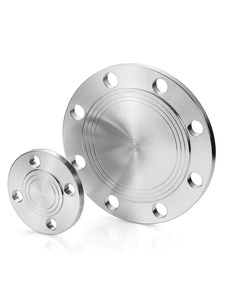
ASME B16.47 covers pressure-temperature ratings, materials, dimensions, tolerances, marking, and testing for pipe flanges in sizes NPS 26 through NPS 60. For mechanical procurement specialists across Israel, understanding the distinction between Series A (MSS SP-44 origin) and Series B (API 605 origin) is vital for structural compatibility, weight management, and pipeline integrity.
Engineered for high external bending moments, seismic tremors, and dynamic pipeline tensions. Series A flanges feature a thicker profile, wider bolt circles, larger diameter bolts, and higher material mass.
Primary Deployment: High-pressure natural gas transmission lines connecting the Tamar and Leviathan gas reception terminals (Ashdod & Dor) to national distribution manifolds managed by INGL (Israel Natural Gas Lines).
Characterized by a tighter bolt circle, smaller diameter bolt holes with higher bolt counts, and lower flange ring thickness. Series B delivers weight savings and smaller footprints in congested plant headers.
Primary Deployment: Chemical processing reactors, heat exchanger heads in the Haifa Bay refining hub (BAZAN Group), compact vessel nozzles, and low-to-medium pressure utility headers.
Standardized facing configurations include Raised Face (RF) with serrated concentric or spiral finishes (125-250 µin Ra) and Ring Type Joint (RTJ) profiles suited for Classes 300, 600, and 900.
Primary Deployment: High-integrity containment for offshore subsea interconnects, hyper-saline brine stages in SWRO plants, and hazardous chemical pipelines requiring zero fugitive emissions.
| Specification Feature | ASME B16.47 Series A | ASME B16.47 Series B | Design Application Notes for Israeli Contractors |
|---|---|---|---|
| Historical Standard | MSS SP-44 | API 605 | Series A and Series B are mechanically non-interchangeable due to differing bolt circles. |
| Nominal Size Range | NPS 26" to NPS 60" (DN 650 to DN 1500) | NPS 26" to NPS 60" (DN 650 to DN 1500) | Series A Blind flanges above 36" require heavy-duty lifting trunnions upon request. |
| Pressure Classes | Class 150, 300, 400, 600, 900 | Class 75, 150, 300, 400, 600, 900 | Class 75 exists exclusively in Series B for low-pressure cooling tower circulating headers. |
| Bolting Design | Fewer bolts, larger bolt diameters | More bolts, smaller bolt diameters | Series A enables faster pneumatic torquing during offshore riser installation. |
| Weight / Rigidity | Higher mass, superior bending stiffness | Lower mass, optimal piping space factor | Series A resists soil shifts in desert pipelines (Negev/Dead Sea) without joint distortion. |
| Typical ASTM Materials | A105, A350 LF2, A182 F316L, F51 Duplex | A105, A182 F304L/F316L, A694 F52/F65 | Duplex 2205 / Super Duplex 2507 heavily favored for coastal desalination infrastructure. |
Israel's infrastructure represents an intensive convergence of offshore gas extraction, desert chemical extraction, and world-leading seawater reverse osmosis (SWRO) installations. Flanges deployed here must withstand extreme mechanical and environmental burdens.
The offshore Leviathan, Tamar, and Karish fields feed domestic energy grids and regional export networks. Subsea landfall manifolds at Ashdod and Hadera utilize ASME B16.47 Series A Weld Neck Flanges forged in low-temperature carbon steel (ASTM A350 LF2 Class 1) and Duplex F51.
Components must meet sour gas qualification pursuant to NACE MR0175/ISO 15156, preventing sulfide stress cracking under high reservoir pressures.
With desalination plants such as Sorek (I & II), Hadera, Ashkelon, and Palmachim supplying upwards of 80% of municipal potable water, hyper-saline brine discharge lines require super-austenitic and duplex stainless steel flanges.
We supply ASME B16.47 28" to 48" flanges in Super Duplex ASTM A182 F53 (2507) and 6-Moly alloys (PREN > 42) capable of repelling aggressive chloride crevice corrosion.
The industrial corridor of Haifa Bay, housing BAZAN Group, Carmel Olefins, and Gadiv Petrochemical Industries, relies on large-bore forged flanges for crude distillation towers, cracking units, and steam reforming lines.
High-temperature operations require Chrome-Moly ASME B16.47 flanges in ASTM A182 F11 and F22, designed to counter hydrogen embrittlement and thermal stress fatigue.
At the Dead Sea Basin, extraction plants operated by ICL (Israel Chemicals Ltd.) process potash, bromine, and magnesium in hyper-mineralized slurries at elevated desert ambient temperatures.
Flanged joints must withstand severe erosive wear and chemical attack. We manufacture custom-bored B16.47 reducing and blind flanges in Hastelloy C276, Titanium Gr. 2, and rubber-lined carbon steel.
Israel's engineering procurement sector operates under strict European harmonized standards alongside foundational American ASME/API codes. EPC contractors, including companies managing IEC (Israel Electric Corporation) retrofits, face evolving sourcing prerequisites:
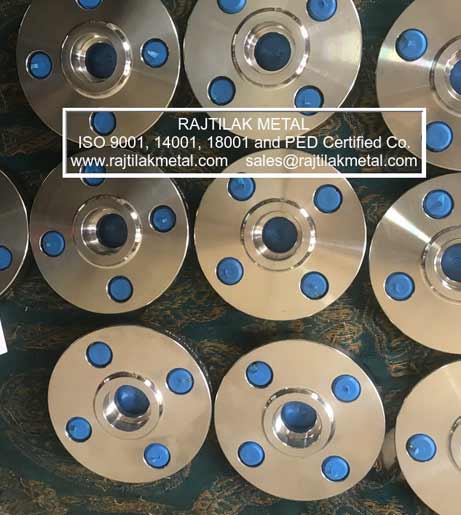
Headquartered in Mumbai, India, with direct logistical access to major global shipping lanes, Rajtilak Metal is an Indian Government Recognised Export House and premier forged flange manufacturer holding comprehensive international quality credentials.
Our forging workflows maintain full compliance under ISO 9001, Indian Boiler Regulations (IBR), and Engineers India Limited (EIL). Our flanges comply with global energy authority audits, including previous project deliveries for ADNOC tier-1 engineering schemes.
Equipped with high-tonnage hydraulic forging presses, ring rolling units, and specialized CNC vertical turning lathes (VTL), we machine ASME B16.47 flanges up to 60" diameter with tight dimensional tolerances, controlled heat cycles, and mirror gasket facings.
Every single flange is physically hard-stamped with melt heat numbers, standard designation, pressure rating, size, wall schedule, and grade. Each shipment is paired with comprehensive 3.1 material test certificates documenting chemical and mechanical properties.
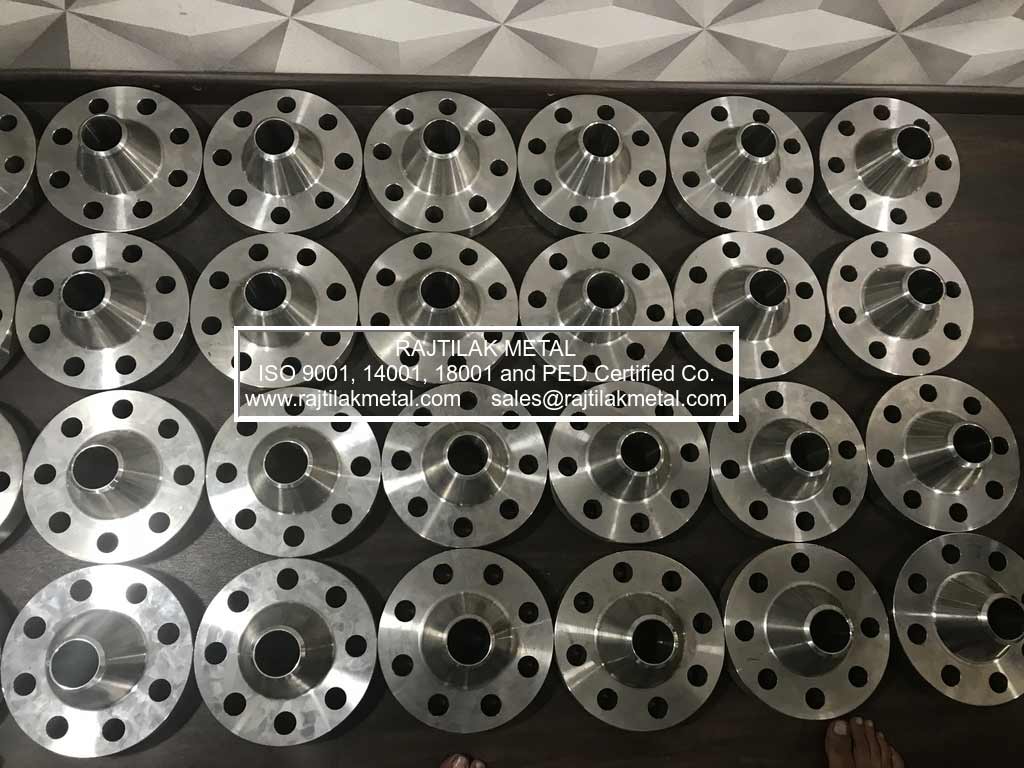
For critical infrastructure in the Levant Basin, joint failure is not an option. Rajtilak Metal utilizes an in-house laboratory suite that performs testing throughout production:
Direct technical answers addressing standards, certifications, freight logistics, and metallurgical specifications for purchasers across Tel Aviv, Haifa, Ashdod, and Beer Sheva.