Girgaon, Mumbai, Maharashtra 400004, India [email protected] +91 9869506920
Precision Engineering • ASTM A403 WP304L

OEM/ODM ASTM A403 WP304L Factory & Supplier

Global certified manufacturing partner for precision austenitic stainless steel buttweld pipe fittings, heavy forged flanges, and cryogenic pipeline connections engineered to ASME B16.9 and MSS SP-43 specifications.

Metallurgical Foundations of ASTM A403 WP304L

A rigorous examination of grain boundary sensitization mitigation, chromium carbide precipitation resistance, and mechanical compliance across cryogenic and elevated operating envelopes.

Ultra-Low Carbon Chemistry

By enforcing a rigorous maximum carbon threshold of ≤ 0.030%, Grade WP304L prevents the formation of intergranular chromium carbide (Cr23C6) precipitates in the critical sensitizing range of 425°C to 850°C (800°F to 1560°F) during high-amperage welding cycles.

IGC Resistance Testing

Every melting charge is subjected to Intergranular Corrosion (IGC) qualification in accordance with ASTM A262 Practice E (Copper-Copper Sulfate-Sulfuric Acid Test), verifying zero micro-fissuring and preservation of passive chromium oxide films under boiling acid exposures.

Full Solution Annealing

Fittings are thermal-treated at an exact baseline of 1040°C to 1150°C (1900°F to 2100°F) followed by rapid water quenching to ensure complete austenitic phase re-homogenization, nullifying residual internal stresses induced during cold press forming or hot mandrel expanding.

Technical Insight for Lead Piping Engineers: ASTM A403 defines four distinct fitting sub-classes: Class WP-S (Seamless wrought components made from seamless pipe or billet), Class WP-W (Welded components where the fitting fabricator's welds are radiographically examined across all seam lengths), Class WP-WX (Welded fittings containing welds that have been 100% radiographed including the original pipe seam weld), and Class CR (Special light-gauge construction governed by MSS SP-43). Our factory delivers full 100% Digital Radiography (DR) testing reports alongside traceable EN 10204 3.1 mill test certificates.
ASTM Grade / Class Carbon (C) Max Chromium (Cr) Nickel (Ni) Tensile Strength (min) Yield Strength 0.2% (min) Elongation (min)
ASTM A403 WP304L (UNS S30403) 0.030% 18.00 – 20.00% 8.00 – 12.00% 70 ksi [485 MPa] 25 ksi [170 MPa] 28%
ASTM A403 WP304 (Standard) 0.080% 18.00 – 20.00% 8.00 – 11.00% 75 ksi [515 MPa] 30 ksi [205 MPa] 28%
ASTM A403 WP316L (Comparison) 0.030% 16.00 – 18.00% 10.00 – 14.00% (2-3% Mo) 70 ksi [485 MPa] 25 ksi [170 MPa] 28%
Dual Certified 304/304L 0.030% 18.10 – 19.50% 8.20 – 10.50% 75 ksi [515 MPa] 30 ksi [205 MPa] 30%
34+
Years Engineering (Since 1991)
100%
In-House PMI & Hydrostatic Testing
11+
Advanced Testing Systems
60+
Global EPC Export Destinations

OEM/ODM Manufacturing & Fabrication Scope

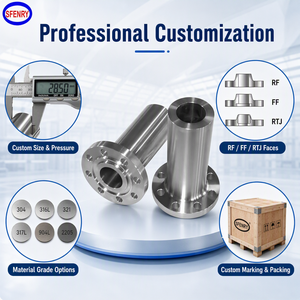
From seamless cold hydro-bulging to large-radius mandrel induction bending, our Mumbai facility delivers non-standard wall thicknesses, custom radius elbows, and pre-machined weld bevels matching complex spool specifications.

Custom Dimensional Geometry

  • ASME B16.9 & MSS SP-43: 1/2″ through 48″ NPS seamless and welded fittings.
  • Wall Thickness Scope: SCH 5S, 10S, 40S, 80S, 160, through XXS.
  • Compound Elbows: Custom 3D, 5D, 8D, and 10D long radius induction bends engineered for minimum flow friction.
  • Complex Manifolds: Reducing lateral tees, unequal crosses, and eccentric conical reducers machined to customer isometric drawings.

Precision Beveling & Facing

  • Standard Bevels: ASME B16.25 plain, compound bevel, and J-bevel preparation for mechanized orbital robotic welding.
  • Bore Calibration: Internal counterboring (taper transition) to prevent turbulence in high-velocity pipelines.
  • Flange Interface: Custom serrated spiral or concentric grooving (Ra 3.2 to 6.3 μm) for stub ends mating with lap-joint flanges.
  • Surface Treatment: Immersion acid pickling, passivation per ASTM A380/A967, and mirror mechanical electro-polishing down to Ra < 0.4 μm.

Destructive & Non-Destructive Testing

  • Positive Material Identification (PMI): 100% handheld XRF and optical emission spectrometer verification prior to dispatch.
  • Volumetric Examination: Radiographic (RT), Ultrasonic (UT), and Liquid Penetrant Testing (PT) by ASNT Level II certified inspectors.
  • Mechanical Validation: Charpy V-notch impact testing at cryogenic temperatures down to −196°C for LNG lines.
  • Documentation: EN 10204 3.1 / 3.2 certs, WPS/PQR reports, and IBR (Indian Boiler Regulations) Form III-C certification.

Future Procurement Trends in Stainless Steel Piping

Strategic insights for procurement directors: navigating decarbonization mandates, the EU CBAM tax, orbital welding precision demands, and global supply chain reconfigurations.

Get a Quote

Trusted Manufacturing Excellence Since 1991

Established over three decades ago in Mumbai, India, Rajtilak Metal has grown into a premier Government of India Recognised Export House and an ISO certified manufacturer of industrial pipe fittings, forged flanges, and high-tensile fasteners.

Our forgings and welded components are vetted and approved by Engineers India Limited (EIL), Indian Boiler Regulations (IBR), and tier-one EPC contractors operating under strict Middle East standards including ADNOC and Saudi Aramco approved vendor criteria.

  • Traceable Melts: Raw material procured solely from tier-1 primary producers in India, South Korea, and Japan with mill heat identity retained across all processing steps.
  • Comprehensive Marking: Every component is clearly hard-stamped or electro-etched with manufacturer symbol, standard (ASME B16.9), material grade (WP304L), size, schedule, and heat number.
  • Seaworthy Packaging: Export packing in treated wooden boxes, end caps, and rust-preventive shrink wrapping ensuring flawless transit via Nhava Sheva (JNPT) port.
ISO 9001:2015 EIL Approved IBR Approved EN 10204 3.1 / 3.2

Global Service & Export Footprint

Consistently supplying turnkey petrochemical complexes, LNG receiving terminals, offshore platforms, and thermal power projects across over 15 countries:

United Arab Emirates Saudi Arabia Qatar Oman Singapore Malaysia Indonesia United States United Kingdom Italy Poland
Dedicated Export Liaison Team Get a Quote

Frequently Asked Questions on ASTM A403 WP304L

Expert clarifications addressing technical compliance, mill test verification, pressure class equivalencies, and fabrication tolerances.

What is the fundamental metallurgical difference between ASTM A403 WP304 and WP304L?
The decisive difference lies in carbon concentrations. ASTM A403 WP304 allows a carbon maximum of 0.080%, whereas WP304L mandates an upper limit of ≤ 0.030%. This lower carbon content stops chromium carbides from precipitating along grain boundaries during welding, preventing sensitization and intergranular stress corrosion cracking without requiring post-weld solution annealing.
What is the technical significance of the "WP-S", "WP-W", and "WP-WX" suffixes?
Under ASTM A403, these designations communicate product construction and non-destructive examination (NDE) history: WP-S: Seamless fittings manufactured from seamless pipe or forgings without fusion welds. WP-W: Welded fittings fabricated from welded pipe or plate where all fitting weld seams are radiographically examined. WP-WX: Welded fittings where all welds, including the original longitudinal weld seam of the starting pipe material, have undergone 100% radiographic inspection.
Can ASTM A403 WP304L buttweld fittings replace ASTM A182 F304L components?
They serve different structural roles within a piping system. ASTM A403 covers wrought buttweld pipe fittings (such as elbows, tees, reducers, and caps), while ASTM A182 applies to forged components such as flanges, forged socket weld fittings, and threaded unions. Both share identical chemical composition and solution heat-treatment baselines, ensuring seamless welding compatibility across identical pipe schedules.
How are pressure ratings determined for buttweld fittings manufactured to ASME B16.9?
Unlike flanges which feature designated Class ratings (Class 150 to 2500), buttweld fittings manufactured under ASME B16.9 are designed to match the burst pressure calculation of straight seamless pipe of equivalent material grade, nominal diameter, and schedule wall thickness. Proof testing (burst testing) per ASME B16.9 Section 9 validates that the fitting will withstand pressure equal to or exceeding calculated pipe ratings.
What documentation accompanies each export shipment of fittings?
Every production batch includes an authenticated EN 10204 3.1 Mill Test Certificate detailing electric furnace melt chemical analysis, tensile testing, 0.2% yield strength, elongation, Rockwell/Brinell hardness, heat treatment chart verification, and results of ASTM A262 Practice E intergranular corrosion tests. Third-party inspection (TPI) agency sign-offs (e.g., DNV, Lloyd's Register, BV, TÜV) to EN 10204 3.2 are available upon request.
What surface passivation protocols are executed prior to shipment?
Following hot forming, sizing, and solution heat treatment, all fittings undergo complete immersion in nitric-hydrofluoric acid baths to remove heat tint, free iron contaminants, and oxide scales. The passivated surface is then tested in accordance with ASTM A380 or ASTM A967 (Ferroxyl or water-wetting test) to confirm the formation of a continuous, self-healing chromium oxide film.

Ready to Initiate Your Project Technical Offer?

Connect directly with our senior metallurgical applications desk in Mumbai. We provide comprehensive line-item pricing, CAD drawing confirmations, and EN 10204 3.1 compliance documentation within 24 hours.
Get a Quote