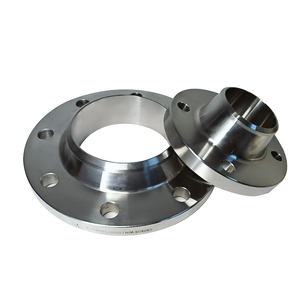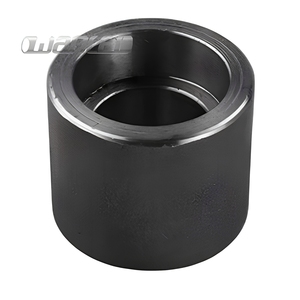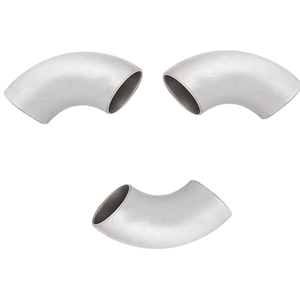
Engineered to strict dimensional tolerances in ASME, EN, DIN, and JIS standards. Manufactured from certified closed-die and open-die forgings with EN 10204 3.1 chemical and mechanical traceability.
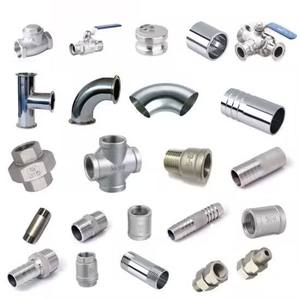
A comprehensive evaluation of screwed flange mechanics, thread geometry, sealing integrity, and stress distribution in industrial high-integrity fluid systems.
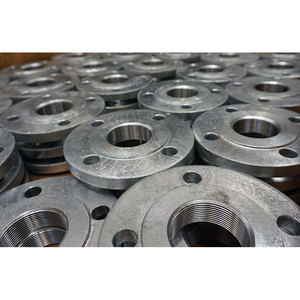
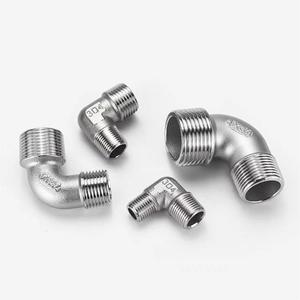
Threaded flanges (also termed screwed flanges) rely on mechanical thread engagement rather than circumferential fillet or buttweld attachments. In accordance with ASME B16.5 and ASME B1.20.1, American National Standard Taper Pipe Threads (NPT) maintain a 1:16 taper angle (3/4 inch per foot) with a 60-degree flank angle. When torqued, the pitch diameters of external pipe threads and the internal flange bore wedge together. Conversely, EN 1092-1 Type 13 and BS 21 / ISO 7-1 (BSPT/Rc) employ a 55-degree Whitworth profile. Mumbai manufacturers maintain dual tooling setups to avoid critical cross-threading risks during brownfield plant modifications.
ASME B16.5 limits the application of threaded flanges based on thermal cycling, external bending moments, and severe cyclic conditions. In Class 150 and Class 300 ratings, threaded flanges are standard for utility air, cooling water, and general hydrocarbon transfer. For Class 600 through Class 2500, applications are strictly circumscribed: while permitted for high-pressure compact instrumentation take-offs, critical process piping codes prohibit threaded connections in toxic, flammable, or explosive service unless a full-penetration seal weld is applied behind the thread profile to eliminate potential helical leakage paths.
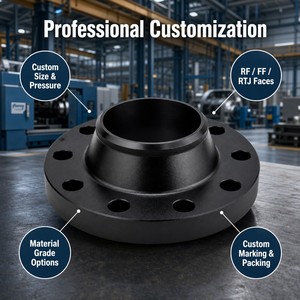
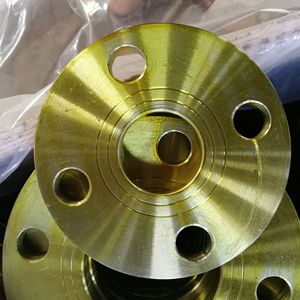
The sealing integrity of a screwed flange assembly depends entirely on the bolt preload transmitted across the gasket seating face. Mumbai forge facilities produce Raised Face (RF), Flat Face (FF), and Ring Type Joint (RTJ) profiles. Raised face geometries feature phonographic serrations with a roughness average between Ra 3.2 µm and 6.3 µm (125–250 AARH), ensuring mechanical bite into spiral wound graphite gaskets without causing localized structural crushing of the sealing element during hydrotesting.
Engineered for EPC procurement contractors and QA/QC inspection agencies. Full compliance across ASME, ASTM, and European standards.
| Flange Standard | Nominal Size Range | Pressure Class / PN | Thread Specification | Common ASTM / ASME Materials | Typical Indian & Export Application |
|---|---|---|---|---|---|
| ASME B16.5 | 1/2" to 24" (Class 150-300) 1/2" to 4" (Class 600-2500) |
Class 150, 300, 600, 900, 1500, 2500 | ASME B1.20.1 NPT Taper | ASTM A105, A350 LF2, A182 F304L/F316L, F11, F22 | Refinery utility skids, offshore living quarters, high-pressure steam drains |
| EN 1092-1 Type 13 | DN 10 to DN 1200 | PN 6, PN 10, PN 16, PN 25, PN 40, PN 63, PN 100 | ISO 7-1 (BSPT / Rc) or ISO 228-1 (G) | P250GH, P245GH, 1.4404 (316L), 1.4307 (304L) | European export modular skids, chemical batch reactors, cooling plants |
| BS 10 / BS 4504 | 1/2" to 12" | Table D, Table E, Table F, Table H | BS 21 Whitworth Taper | Carbon Steel CS-A105, Cast Iron, Austenitic SS | Municipal municipal water infrastructure, legacy mining projects, fire loops |
| JIS B2220 | 10A to 600A | 5K, 10K, 16K, 20K, 30K | JIS B0203 (PT Taper Pipe Thread) | SS400, SF440A, SUS304, SUS316L | Marine shipbuilding, ballast lines, Japanese OEM machinery retrofits |
| API 6A / 16A | 1-13/16" to 4-1/16" | 2000 psi to 10,000 psi | API Spec 5B Line Pipe Thread | AISI 4130, AISI 8630 Mod, ASTM A182 F22 | Wellhead Christmas trees, high-pressure choke lines, offshore manifold tie-ins |
Understanding why Mumbai acts as the undisputed forging and export nucleus for industrial threaded piping components throughout Maharashtra, Gujarat, and global markets.
Offshore exploration platforms and supply vessels operate in high-salinity marine environments where open-flame hot welding is strictly controlled. Forged 316L stainless steel and duplex threaded companion flanges provide dependable, spark-free connections for air utility lines, fuel decanting manifolds, and seawater reverse osmosis lines without costly hot-work shutdown permits.
Complex hydrocarbon processing centers, including the BPCL/HPCL refinery complexes at Mahul and downstream petrochem processing units along the Patalganga-Rasayani strip, utilize ASTM A105 normalized and ASTM A182 F11/F22 alloy threaded flanges for sampling points, thermowell nozzles, chemical dosing skids, and nitrogen purging stations where safety clearances are constrained.
Western India's largest chemical and active pharmaceutical ingredient (API) manufacturing corridor requires sanitary and highly corrosive-resistant piping. Mirror-polished SS316L and Hastelloy C276 threaded flanges are extensively procured for acid transfer manifolds, solvent recovery condensers, and sterile CIP (Clean-in-Place) utility connections requiring modular disassembly for batch validation.
Automotive powertrain casting plants in Chakan and containerized export modular skid builders surrounding Navi Mumbai utilize PN-rated and Class 300 threaded flanges for hydraulic test rigs, compressed dry air (CDA) loops, and high-pressure steam distribution headers destined for Middle Eastern and Southeast Asian EPC delivery via Jawaharlal Nehru Port (JNPT).
Key technological, structural, and regulatory shifts elevating Indian flange factories into Tier-1 global vendors.
Traditional manual lathe chasing and thread cutting dies frequently produced micro-chatter, pitch lead errors, and inconsistent crest geometry, resulting in galling when assembling stainless steel components. Modern Mumbai flange factories have invested heavily in multi-axis CNC turn-mill centers programmed with single-point threading cycles. This transition guarantees pitch tolerance down to ±0.01 mm, maintaining flawless thread engagement even across high-nickel alloys like Inconel 625 and Monel 400.
With Middle Eastern clients (ADNOC, Saudi Aramco, PDO) and offshore Indian operators drilling into higher hydrogen sulfide (H2S) reservoirs, threaded flanges must resist Sulfide Stress Cracking (SSC). Leading Mumbai suppliers now guarantee strict hardness control (maximum 22 HRC in carbon steels per NACE MR0175 / ISO 15156), combined with mandatory vacuum degassing during melting and Charpy V-notch impact testing down to -46°C for ASTM A350 LF2 forgings.
As Maharashtra prioritizes industrial green hydrogen clusters, pipeline standards are evolving. Hydrogen's tiny molecular size makes conventional mechanical joints susceptible to micro-leakage. Mumbai's leading manufacturers are redesigning threaded flange internal thread root geometries and developing hybrid threaded-plus-seal-weld designs with zero mechanical porosity, facilitating the transition toward renewable energy transmission infrastructure.
Headquartered in the historic commercial heart of Girgaon, Mumbai, Rajtilak Metal has grown from an industrial forging supplier into a Government of India Recognised Export House. Operating state-of-the-art forging hammers, heat-treatment furnaces, and CNC machining centers, we serve critical energy and utility infrastructure globally.
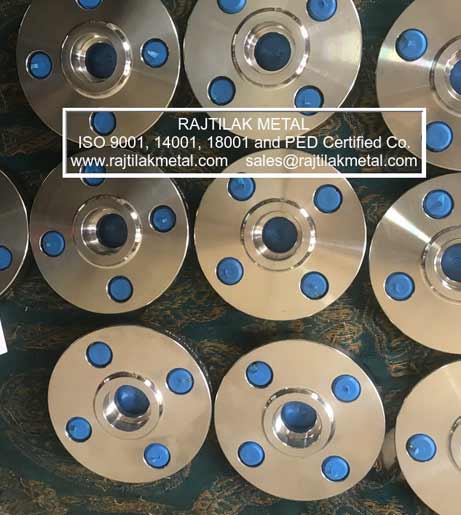
Stocking over 15,000 MT of forgings, ANSI/ASME/EN flanges, buttweld fittings, and high-tensile alloy fasteners.
Key metallurgical, compliance, and commercial guidance addressing common technical hurdles encountered by international and domestic procurement teams.
Submit your line item schedule, piping class datasheets, material grades, and thread requirements. Our engineering procurement desk in Girgaon, Mumbai provides comprehensive commercial offers with verified lead times within 4 hours.
Get a Quote