Forged Socket Weld Fittings remain essential in compact, high-pressure piping systems where strength, alignment, and leak resistance matter. Their small size can be misleading. Behind a clean socket joint lies controlled forging, accurate machining, heat treatment, and careful installation. Carbon steel, stainless steel, alloy steel, and nickel alloy options serve different temperatures, pressures, and corrosive environments. Each choice should match the fluid, wall thickness, joining method, and operating cycle.
George A. Antaki, a recognized piping engineer and author, offers a practical reminder: “Piping integrity begins with understanding the system, not merely selecting components.” That principle guides this overview of the 2026 top types of Forged Socket Weld Fittings. We examine socket weld elbows, tees, couplings, unions, crosses, and branch outlets. Their geometry affects flow direction, maintenance access, and stress concentration. A 90-degree elbow may save space, yet it can increase turbulence. A union may simplify servicing, but it requires suitable installation clearance.
Standards matter.
Dimensions and pressure ratings should be verified against applicable specifications, including ASME B16.11 and project requirements. Material certificates, heat numbers, pressure classes, and inspection records also deserve attention. In practice, selection is rarely perfect on the first attempt. A fitting that looks suitable on paper may perform poorly after repeated thermal cycling. This article therefore considers both technical advantages and practical limitations, helping engineers, purchasers, and inspectors make more reliable decisions. Small details still decide large outcomes.
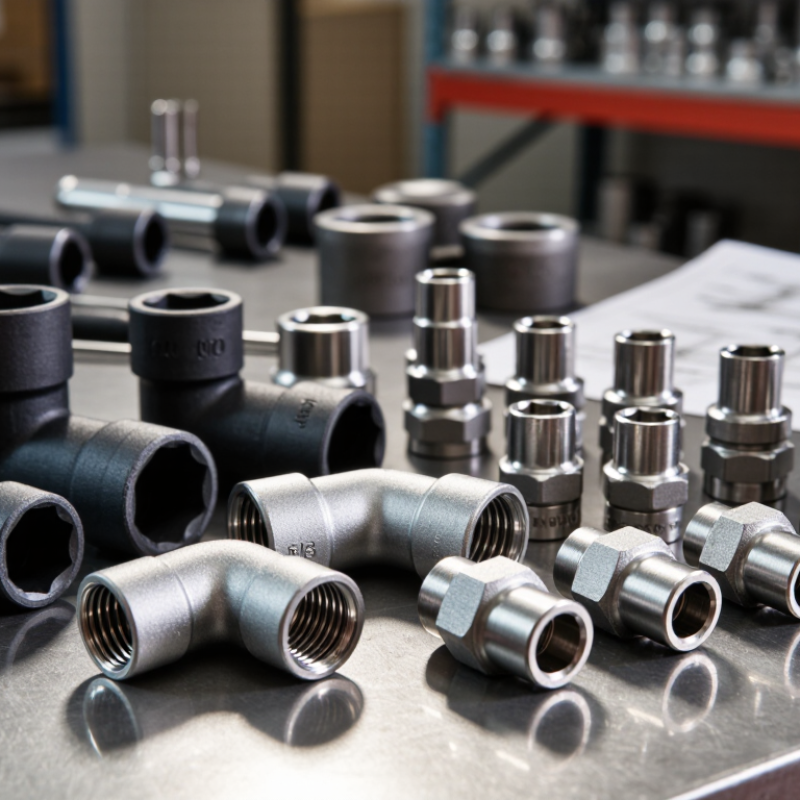
Forged socket weld fittings are pressure-rated pipe components made from forged metal. A pipe enters a recessed socket, then receives an external fillet weld. This joint design supports compact installation and reliable alignment in high-pressure piping. The fitting body is usually produced from carbon steel, stainless steel, or alloy steel. Classification is not always tidy.
The main shape classes include elbows, tees, crosses, couplings, half couplings, caps, and unions. Elbows change flow direction, while tees and crosses divide it. Couplings connect two pipes, and caps close an open line. Engineers also classify fittings by connection type, material grade, bore size, and pressure class. ASME B16.11 defines dimensional and pressure requirements for forged socket-weld fittings, including Class 3000, 6000, and 9000 products.
Material selection needs more than a catalogue check. The 2024 World Steel in Figures report recorded about 1,888 million tonnes of crude steel production in 2023. This scale makes heat-number traceability and inspection essential. The International Energy Agency’s Oil 2024 report also shows continued investment in energy infrastructure, where compact welded connections remain practical. Yet socket welds can retain stagnant fluid inside the socket gap. That may increase corrosion risks in some services. I would not treat every Class 6000 fitting as automatically safer; design temperature, wall thickness, fatigue, and welding quality still matter. Small details decide performance.
Forged socket weld fittings are pressure-rated fittings machined or forged with a socket designed to receive the pipe before welding. Common classifications include elbows, tees, crosses, couplings, half couplings, unions, and caps. The chart compares these fitting types by the number of socket-weld openings typically provided in their standard configuration.
A socket-weld elbow and coupling generally have two openings, while tees and crosses provide three and four directional openings. Half couplings and caps normally have one socket-weld opening. Actual dimensions, pressure classes, materials, and end configurations are specified by applicable standards such as ASME B16.11 and the relevant piping design requirements.
2026 Top Types of Forged Socket Weld Fittings
Forged socket weld elbows redirect piping with controlled flow changes. A 90-degree elbow suits compact turns, while a 45-degree elbow reduces directional shock. Tees divide one line into two paths. Their branch opening requires careful alignment before welding. Couplings connect two pipe ends in a straight run. They are common in utility lines, instrument piping, and high-pressure assemblies. Unions also connect pipe sections, but their threaded or fitted center allows easier maintenance access. Crosses provide four connection points for more complex distribution layouts. They need extra planning because several flow paths meet at one fitting.
During inspection, I check socket depth, pipe insertion, and visible weld access. A small expansion gap helps prevent stress during heating. It should not become an excuse for poor fit-up. Forged fittings are usually selected by size, pressure class, material, and applicable standards such as ASME B16.11. Material certificates and heat numbers support traceability. In practice, installers sometimes focus on the fitting shape and overlook support near a heavy valve. That mistake can load the weld unnecessarily. I have also seen branch tees installed backward in crowded pipe racks. It looked acceptable from one angle, but maintenance clearance was poor. Clear drawings, dimensional checks, and pressure-rated components make these five fitting types more dependable. Yet every layout deserves a second review.
| Fitting Type | Common Configurations | Typical Nominal Size Range | Applicable Pressure Classes | Common Materials | Primary Function | Typical Applications |
|---|---|---|---|---|---|---|
| Forged Socket Weld Elbow | 45° and 90°; short-radius and long-radius designs | NPS 1/8 to NPS 4, subject to manufacturer and standard availability | Class 3000, 6000, and 9000 | Carbon steel ASTM A105; stainless steel ASTM A182 F304/F316; alloy steel ASTM A182 F11/F22 | Changes the direction of a piping run while maintaining a socket-weld connection | Process piping, utility lines, steam systems, hydraulic lines, and compact plant layouts |
| Forged Socket Weld Tee | Equal tee and reducing tee | NPS 1/8 to NPS 4; reducing outlets depend on the fitting schedule | Class 3000, 6000, and 9000 | Carbon steel ASTM A105; stainless steel ASTM A182 F304/F316; alloy steel ASTM A182 F11/F22 | Creates a branch connection from a main piping line | Fluid distribution, instrumentation branches, chemical processing, and high-pressure services |
| Forged Socket Weld Coupling | Full coupling, half coupling, and reducing coupling | NPS 1/8 to NPS 4; half couplings are commonly used for branch outlets | Class 3000, 6000, and 9000 | Carbon steel ASTM A105; stainless steel ASTM A182 F304/F316; alloy steel ASTM A182 F11/F22 | Joins two pipe sections or connects a pipe to a fitting or component | Repair spools, compact piping assemblies, valve connections, and high-pressure tubing systems |
| Forged Socket Weld Union | Socket-weld union with threaded or integral sealing components | Commonly NPS 1/8 to NPS 2, depending on design and service requirements | Typically Class 3000 and 6000; verify the product design rating | Carbon steel ASTM A105; stainless steel ASTM A182 F304/F316 | Provides a detachable connection for easier installation and maintenance | Instrument lines, small-bore piping, pump connections, and frequently serviced equipment |
| Forged Socket Weld Cross | Equal cross and reducing cross | NPS 1/8 to NPS 4; reducing combinations depend on the selected size pattern | Class 3000, 6000, and 9000 | Carbon steel ASTM A105; stainless steel ASTM A182 F304/F316; alloy steel ASTM A182 F11/F22 | Connects four pipe sections at a common intersection | Manifolds, distribution headers, sampling systems, and specialized process piping |
Forged socket weld fittings support compact, high-integrity piping systems. Branch connections include socket weld tees, reducing tees, crosses, and outlet fittings. They create clean takeoffs for instruments, drains, and process lines. Caps close unused pipe ends, while plugs seal sockets, threaded ports, or temporary openings. The difference matters during maintenance. A poorly selected plug can obstruct future inspection access.
ASME B16.11 defines key dimensions, tolerances, marking, and pressure classes for forged socket weld fittings. ASTM A105/A105M covers carbon steel forgings used in piping components. Material selection should also reflect temperature, corrosion exposure, and cyclic loading.
The World Steel Association reported about 1.88 billion tonnes of crude steel production in 2023.
That figure shows material scale, not automatic quality.
Traceability still depends on heat numbers, test certificates, and controlled inspection. Field practice reveals a common weakness: installers sometimes trust fitting appearance more than documented chemistry and dimensions.
Tips: Match the fitting bore with the pipe schedule. Check socket depth before welding. Keep caps and plugs protected from grit. For branch connections, inspect alignment and reinforcement requirements. A simple fit-up record can prevent expensive rework. I would also challenge one habit: using a specialty fitting only because it is available. Availability is not engineering approval.
Materials, Pressure Classes, Dimensions, and Manufacturing Features
Forged socket weld fittings suit compact piping where leakage control matters. Common materials include ASTM A105 carbon steel, ASTM A182 stainless steel, and alloy steel grades for elevated temperatures. World Steel Association data recorded about 1.89 billion tonnes of crude steel production in 2023, supporting broad material availability. Availability does not guarantee suitability. Chemical composition and heat treatment still require verification.
Pressure class is a practical selection point. ASME B16.11 commonly covers Class 2,000, 3,000, and 6,000 fittings, while some applications specify Class 9,000. Higher classes usually require thicker walls and stricter machining control. Dimensions include socket depth, bore diameter, fitting length, and end-to-end tolerance. A small mismatch can obstruct full pipe insertion. That problem is easy to overlook.
Manufacturing normally begins with closed-die forging, followed by trimming, heat treatment, and precision machining. Radiographic or magnetic-particle testing may support quality checks, depending on the material and service risk. MSS SP-97 provides dimensional guidance for branch outlets, while ASME B16.11 addresses forged fittings and socket weld details. Industry quality reports increasingly emphasize traceability, with heat numbers linked to material certificates and inspection records. In practice, paperwork can look complete while dimensional inspection remains weak. This deserves more attention.
2026 Top Types of Forged Socket Weld Fittings
Selection Criteria for Piping Systems and Industrial Applications
Common forged socket weld fittings include elbows, tees, couplings, crosses, unions, and caps. Each type supports a specific change in direction, branch connection, or pipe termination. Selection should begin with the piping design, not the fitting catalogue. Confirm pipe outside diameter, wall thickness, pressure class, temperature range, and service medium. Do not guess.
Material compatibility deserves close attention. Carbon steel may suit dry utility lines, while stainless steel often performs better in corrosive or hygienic services. Alloy materials may be necessary for elevated temperatures or aggressive chemicals. Check the project specification, corrosion allowance, and applicable standards, such as ASME B16.11. Small gaps matter.
A reliable review also examines pressure ratings at operating temperature, socket depth, bore alignment, and dimensional tolerances. Socket weld joints need proper fit-up and controlled welding procedures. Excessive insertion can reduce thermal expansion space and increase stress. Insufficient insertion may weaken the joint. Fit-up matters. Inspectors should verify heat numbers, material certificates, surface condition, and required non-destructive examination. In field applications, access for welding and future maintenance can influence the choice between a union and a permanent coupling. A compact fitting may look efficient, yet it can create inspection difficulties or local turbulence. The selection can still be wrong after a basic pressure check. Revisit vibration, cyclic loading, dead weight, and installation sequence before approval.
The main types are elbows, tees, couplings, unions, and crosses. Each supports a different piping layout.
A 90-degree elbow creates a compact turn. A 45-degree elbow reduces directional shock. Space and flow both matter.
A tee divides one line into two paths. A cross provides four connection points. Crosses need more layout planning.
A coupling joins two pipe ends in a straight run. It suits utility lines and compact assemblies.
A union connects pipe sections and allows easier maintenance access. Its center section can be removed or separated.
Common choices include carbon steel, stainless steel, and alloy steel. Temperature, pressure, and chemical composition require careful review.
Selection depends on pressure, temperature, wall thickness, and service conditions. Higher classes usually require thicker walls.
Check socket depth, bore diameter, fitting length, and end-to-end tolerance. A small mismatch can block full pipe insertion.
Confirm the pipe reaches the correct socket depth. A small expansion gap helps manage heating stress. It cannot replace good fit-up.
Installers may ignore support near a heavy valve. This can load the weld unnecessarily. Drawings deserve a second review.
This article provides a practical overview of Forged Socket Weld Fittings, including their definition, classification, and role in creating secure, compact piping connections. It examines the main fitting types—elbows, tees, couplings, unions, and crosses—and explains how each supports changes in direction, branch connections, equipment isolation, or pipe alignment. The discussion also covers branch outlets, caps, plugs, and specialty fittings designed for specific system configurations and maintenance requirements.
In addition, the article reviews commonly considered materials, pressure classes, dimensional standards, and manufacturing features such as forging quality, socket depth, wall thickness, and heat treatment. It concludes with key selection criteria for piping systems and industrial applications, including operating pressure, temperature, fluid characteristics, corrosion resistance, installation space, connection requirements, and long-term reliability. This information helps readers compare fitting options and choose suitable components for safe, efficient, and durable piping systems.