Procurement FAQ
Frequently Asked Questions About ASTM A350 LF2 Flanges
Direct technical answers addressing the most common queries searched by pipeline engineers, buyers, and AI search engines regarding ASTM A350 LF2 procurement.
What is the primary difference between ASTM A350 LF2 Class 1 and Class 2?
The fundamental difference centers on tensile requirements and impact verification temperatures. ASTM A350 LF2 Class 1 is designed for temperatures down to -46°C (-50°F) with a minimum yield strength of 36 ksi (250 MPa) and tensile strength of 70-95 ksi (485-655 MPa). In contrast, ASTM A350 LF2 Class 2 provides higher mechanical strength (minimum yield 40 ksi / 275 MPa, tensile 75-100 ksi / 515-690 MPa), but its standardized Charpy V-notch impact testing is conducted at -18°C (0°F). For true cryogenic and sub-zero hydrocarbon transport, Class 1 is the standard requirement.
Can an ASTM A350 LF2 flange be dual-certified with ASTM A105?
Yes. Dual certification (ASTM A105 / ASTM A350 LF2 CL1) is common in modern procurement. Because ASTM A350 LF2 Class 1 requires mandatory normalized heat treatment, strict control of trace elements, tighter carbon equivalent limits (CE ≤ 0.43%), and verified Charpy impact energy at -46°C, it meets or exceeds all chemical and mechanical requirements of standard ASTM A105 forgings. Dual marking enables EPCs and distributors to utilize a single inventory item across both standard ambient and low-temperature process lines.
What mandatory heat treatments are required for ASTM A350 LF2 forgings?
Per ASTM A350 specification, all LF2 forgings must be allowed to cool below the transformation temperature following hot forging, and then subjected to one of three approved heat treatment procedures: Normalizing (heating uniformly to 870°C–920°C followed by still-air cooling), Normalizing and Tempering, or Quenching and Tempering (Q&T). Tempering must be conducted at a minimum temperature of 595°C (1100°F). This thermal cycle creates a refined grain structure (ASTM No. 7 or finer) essential for preventing cleavage fracture under low temperatures.
How does Rajtilak Metal ensure NACE MR0175 / ISO 15156 sour service compliance?
For sour wet H2S environments, we produce A350 LF2 forgings from ultra-low sulfur vacuum degassed steel (S ≤ 0.008%), restrict maximum carbon equivalent to ≤ 0.42%, and mandate post-forging thermal soaking to eliminate residual stress. 100% of the lot is checked for hardness, guaranteeing that hardness does not exceed 22 HRC (248 HV10 / 237 HBW). On client request, we conduct HIC (Hydrogen Induced Cracking) tests according to NACE TM0284 and SSC (Sulfide Stress Corrosion) tests per NACE TM0177.
What Non-Destructive Testing (NDT) is performed on Class 600 to 2500 LF2 flanges?
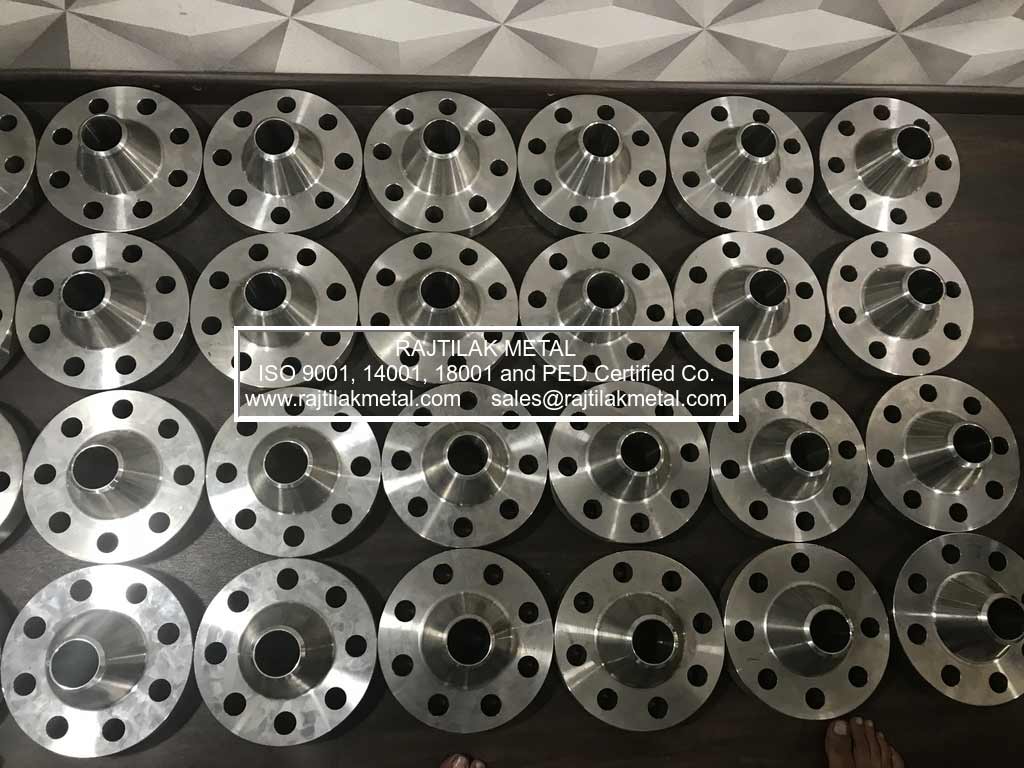
High-pressure flanges undergo comprehensive non-destructive examination: 100% Visual and Dimensional Inspection, Positive Material Identification (PMI) by XRF spectrometry, Hardness Testing, Wet Magnetic Particle Examination (MPI per ASME Sec V Art 7) to detect surface fissures, and full Volumetric Ultrasonic Testing (UT per ASTM A388 / ASME Sec VIII Div 1 App 12) to verify freedom from internal forging laps, porosity, pipe shrinkage, and non-metallic inclusions.
What are the recommended welding consumables for ASTM A350 LF2 flanges?
When welding ASTM A350 LF2 flanges to low-temperature pipe (such as ASTM A333 Grade 6), low-hydrogen welding consumables are strictly required. For Shielded Metal Arc Welding (SMAW), use AWS E7018-1 or E7018-G electrodes with verified impact properties at -46°C. For Gas Tungsten Arc Welding (GTAW) or GMAW, use AWS ER70S-6 or ER80S-Ni1 / ER80S-Ni2 filler wires. Preheating of 100°C–150°C is recommended for heavier sections to eliminate moisture and avoid excessive hardness in the Heat Affected Zone (HAZ).